How SoCal's Fitness Crowd Keeps Their Nutrition on Point

Here's a funny thing you notice once you've been around fitness long enough: the people who actually look like they train are usually doing the most boring thing imaginable. They eat roughly the same high-protein meals, on repeat, without really thinking about it. Meanwhile, all the flashy stuff, the brand-new supplement, the elaborate diet protocol, the big cheat-day theatrics, tends to belong to the folks who are still spinning their wheels. And in a region as fitness-obsessed as Southern California, that gap between getting results and getting nowhere comes down less to the workout than you'd think, and more to whether the eating is actually consistent. The catch is that consistency is a logistics problem, not a motivation one.
So let me walk you through how the people who stay lean and strong really handle their food. It's not hacks. It's a system that quietly makes hitting their numbers the default, so they don't have to be a hero about it every single day.
Training works, but nutrition decides the result
You can train hard five days a week and still spin in place if the eating around it is random. Here's why. The workout creates the stimulus, but the food, and protein in particular, is what your body actually uses to recover and build. Miss the food side consistently enough and the training just makes you tired instead of making you better, which is a frustrating place to be when you're putting in the work.
The honest hierarchy looks something like this:
- Total calories set whether you gain, lose, or hold steady.
- Protein protects and builds muscle, whether you're cutting or bulking.
- Carbs and fat fill in your energy and round out the rest.
- Timing and supplements are the small stuff people love to obsess over while quietly ignoring the first three.
Most people who feel genuinely stuck are getting steps one and two wrong, not step four. So the fix usually isn't a smarter program or a cleverer supplement stack. It's hitting your calories and protein consistently, week after unglamorous week.
The number that matters most: protein per day
If you train, protein is the macro to protect above all the others. A practical target for active people is somewhere between 0.7 and 1 gram of protein per pound of body weight per day, leaning toward the higher end when you're trying to build muscle or hold onto it while losing fat. So a 180-pound lifter is looking at roughly 125 to 180 grams a day.
The real trick, though, isn't the daily total sitting there in the abstract. It's 30 to 40 grams per meal, spread across the day, because that spreading-out is genuinely better for your muscle than dumping the whole load at dinner. For the full breakdown of targets and who actually needs more, how much protein you actually need per day goes deeper. But the takeaway is simple enough: each plate has to carry real protein, every day, and that's exactly the thing that quietly falls apart without some kind of system holding it together.
Why consistency beats intensity
Here's the part the fitness industry really undersells, because it doesn't sell anything. A perfectly optimized meal plan you follow three days a week loses, every time, to a merely decent meal plan you follow every single day. Results come from the average, not from the peaks. The person eating a solid, repeatable set of meals will out-progress the person who eats immaculately Monday through Wednesday and then completely falls off by Thursday afternoon.
This is exactly why the strongest move you can make is to render good eating boring and automatic. When your meals are already decided and ready ahead of time, you stop having to rely on willpower at the precise moments willpower is weakest, which is post-workout, late at night, and in the middle of a chaotic day. Removing the decision is what actually makes consistency possible. It's the same reason meal prep works for weight loss when diets don't: you're quietly taking the in-the-moment choices off the table before they can sabotage you.
What a training-day plate looks like
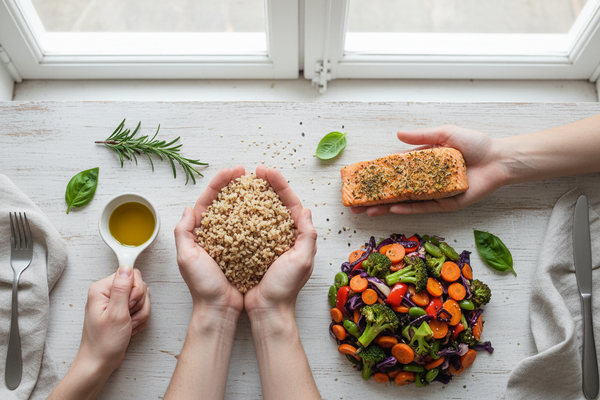
You really don't need exotic food for any of this. A plate that supports training is simple and endlessly repeatable:
- A palm or two of lean protein. Chicken, lean beef, fish, eggs, or a quality protein source, landing in that 30 to 40 gram range.
- A real carb source. Rice, potatoes, quinoa, or oats, scaled to your goal and to how hard you actually train.
- Vegetables and some healthy fat. This is your volume, your fiber, and your micronutrients, the stuff that keeps you full and recovering well.
Build most of your meals on that template and you've covered calories, protein, and the rest without ever opening a spreadsheet. The variety, when you want it, comes from rotating the protein and the carb around, not from reinventing the whole structure every week.
Who needs a meal-prep system (and who doesn't)
I'll be honest with you here. If you love cooking and you've got the time to batch a few pounds of chicken and rice every Sunday, then do exactly that. It's cheaper, it works beautifully, and you don't need anything else from anyone. Plenty of SoCal's fittest people are precisely this person, and there's nothing to fix.
But if your real bottleneck is time, and for a lot of people it is, between a full-time job, a commute, a family, and training that already eats your spare hours, then the cooking is usually the first thing to break. That's the point where prepped meals with the macros already listed genuinely earn their place, because they make hitting your numbers automatic on the exact days you can't cook. The point is really the same either way: the system exists so that your nutrition doesn't end up depending on how motivated you happen to feel that particular night.
Where prepared meals fit
When the cooking is the bottleneck, ready-to-eat meals solve the actual problem rather than dancing around it. Everything arrives cooked, portioned, and labeled, so you know exactly what you're eating and your protein is handled without you ever touching a pan.
That's why a local kitchen like My Healthy Penguin works well for a lot of SoCal's training crowd. Every meal lists its full macros, and the Protein+ plan is built specifically for the people whose protein targets run high. You're not buying a shortcut to results, because that doesn't exist. You're buying the consistency that produces them, by removing the cooking step that kept breaking your week.
FAQ
How much protein do I need to build muscle?
For most active people, somewhere around 0.7 to 1 gram per pound of body weight per day, leaning toward the higher end when you're building muscle. And spreading it across three or four meals at 30 to 40 grams each tends to be more effective than loading the whole day's worth into a single meal.
Do I need supplements to make progress?
No, you really don't. Calories, protein, and consistency drive almost all of your actual results. A protein powder is a convenient way to hit your numbers, and creatine is well supported by the research, but most other supplements are pretty minor next to simply eating enough protein every day.
Should I eat differently on training days versus rest days?
You can nudge your carbs up a bit on hard training days and down a little on rest days if you want to, but honestly it's a fine-tuning move. Hitting your daily calories and protein consistently matters far, far more than shuffling carbs around the calendar.
Is meal prep worth it for fitness, or should I just cook?
If you enjoy cooking and you've got the time, batch-prepping your own is cheaper and works great, no argument there. If time is the thing standing between you and consistency, then prepped meals with listed macros remove the cooking step that usually breaks the plan, which is what makes hitting your numbers automatic.
The bottom line
Results in the gym are decided in the kitchen, and the kitchen is won by consistency rather than intensity. Hit your calories, protect your protein at 30 to 40 grams a meal, build your plates on a simple repeatable template, and make the whole thing automatic so it doesn't hinge on how motivated you feel. Whether you batch-cook it yourself or outsource it, the goal is exactly the same: the same good meals, on repeat, without having to think about it.
If cooking is the thing breaking your consistency, see what is on this week's menu. Every meal lists its macros, and Protein+ is built for higher targets, no subscription required.
Written by the My Healthy Penguin kitchen team. Fresh meal prep made in Rancho Cucamonga, serving Southern California since 2015.
Dinner, already handled.
Fresh, macro-friendly meals delivered across Southern California.