How to Eyeball Portion Sizes Without Weighing Everything
Let me be honest with you about kitchen scales. Almost nobody weighs their food for the rest of their life. What usually happens is you buy one with the best intentions, use it diligently for about two weeks, and then it quietly migrates to the back of a drawer to live next to the broken corkscrew and the takeout chopsticks you keep meaning to use. And you know what? That's completely fine. You don't actually need to weigh everything forever. What you need is a way to get your portions roughly right when you're standing in your kitchen at 7 p.m. with exactly zero patience for grams and a stomach that wants dinner now.
Here's the good news, and it's better than you'd think: your own hand is a surprisingly decent measuring tool, and the best part is that it travels with you everywhere you go. No charging, no batteries, no drawer. Let me walk you through how to use it.
How do you estimate portion sizes without a scale?
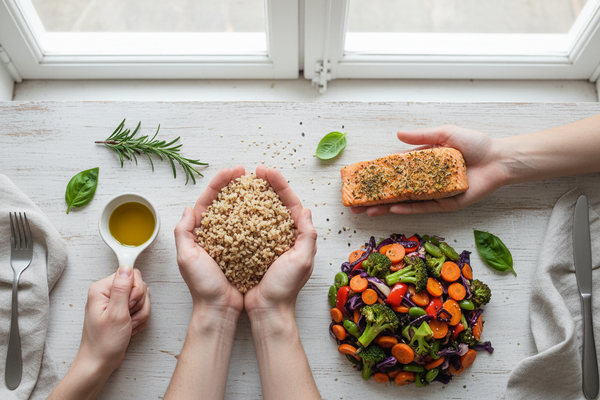
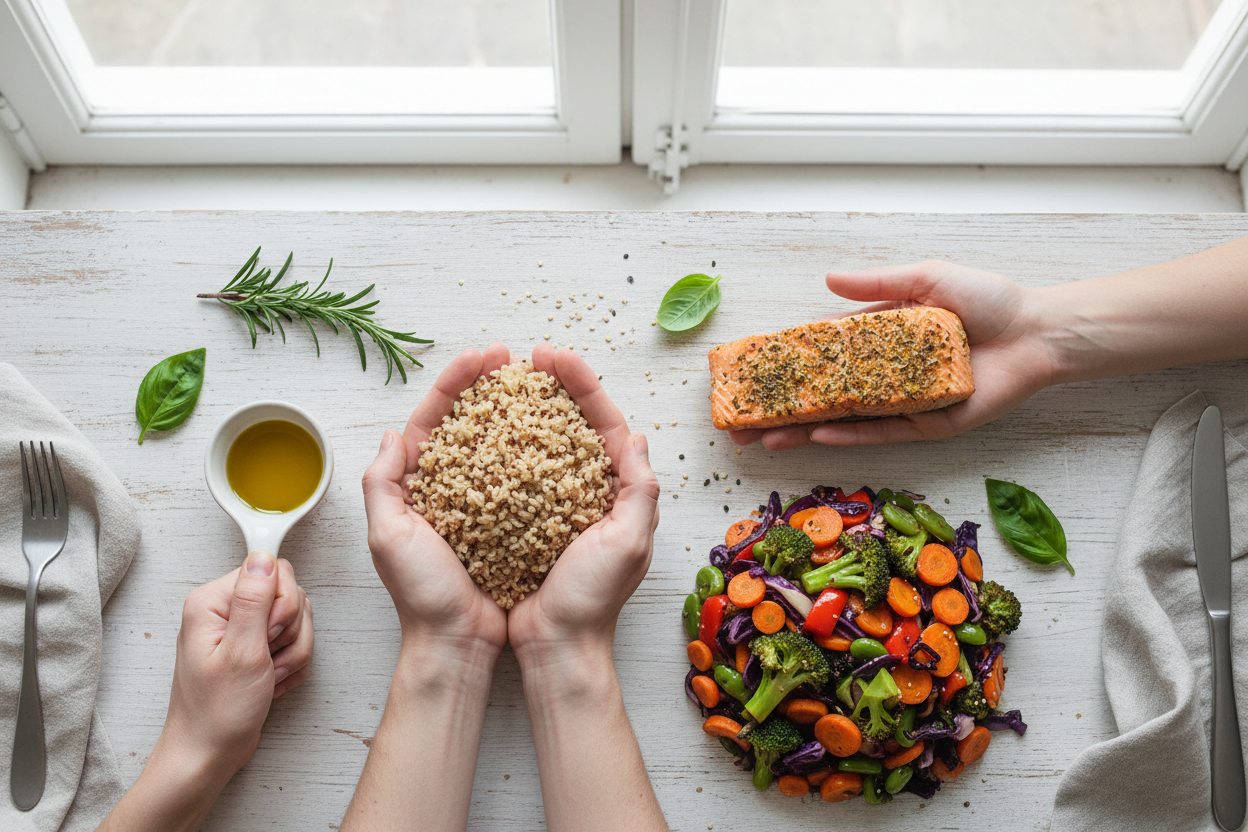
The simplest approach is to treat your hand as a built-in portion guide. The basic recipe is a palm of protein, a fist of vegetables, a cupped handful of carbs, and a thumb of fats per meal, and that's genuinely most of it. The clever part is that your hand naturally scales with your body, so a bigger person automatically gets bigger portions, which is exactly what you want. For most adults this lands a meal somewhere around 400 to 600 calories with a solid hit of protein, and you never measured a single thing. Is it an estimate rather than a lab result? Sure. But here's the thing worth remembering: an estimate you'll actually use beats precise tracking you abandon by Thursday, every single time.
The hand-portion method, spelled out
Let me lay this out properly, because once you see it mapped out it tends to stick. Each part of your hand stands in for a portion of one food group, and you build a plate by stacking them together.
| Your hand | Stands for | Roughly |
|---|---|---|
| Palm (not fingers) | One serving of protein | 20 to 30 g protein |
| Fist | One serving of vegetables | 1 cup |
| Cupped hand | One serving of carbs | 30 to 40 g carbs |
| Thumb | One serving of fat | 1 tablespoon-ish |
A typical balanced meal works out to one to two palms of protein, one to two fists of vegetables, one to two cupped handfuls of carbs, and one to two thumbs of fat. If you're someone smaller or you're trying to lose a little weight, you stay at the low end of those ranges. If you're bigger, very active, or working on building muscle, you slide toward the high end. That, honestly, is the entire system. There's no level two.
To make it concrete, here's how it shakes out depending on what you're after:
- Trying to lose fat: lean toward two palms of protein, two fists of veg, one cupped handful of carbs, and one thumb of fat. Keeping protein and vegetables high is what keeps you full, which is the whole game when you're eating a bit less.
- Active or training hard: go ahead and add a second cupped handful of carbs and a second palm of protein. You're burning through fuel, so give yourself the fuel.
- Maintaining: sit in the middle of every range, and adjust based on the mirror and your energy levels rather than chasing some decimal point.
The plate method, for when you do not want to think
Some days you don't even want to count palms, and I get it. On those days, just fall back on the plate. Picture a standard dinner plate and divide it up in your head like this:
- Half the plate is non-starchy vegetables. Salad, broccoli, peppers, green beans, roasted whatever you've got. This is the part most people quietly skip, and it's the easiest portion in the whole meal to be generous with, so be generous.
- A quarter of the plate is protein. Chicken, fish, lean beef, eggs, tofu, beans, take your pick.
- A quarter of the plate is carbs. Rice, potatoes, pasta, tortillas, fruit.
- A small amount of fat for cooking and flavor, so olive oil, avocado, cheese, a drizzle of dressing.
The plate method is less precise than counting hand portions, but it's almost impossible to mess up in any meaningful way. What it quietly fixes is the single most common portion problem out there, which is a plate that's three-quarters carbs with a sad little piece of protein parked on top. If you build the plate in that order, vegetables first, you'll find you eat a reasonable amount without really trying. The order does the work for you.
Why portions slip even when the food is healthy
Now here's the part people genuinely miss, so stay with me. The foods that wreck your portion control usually aren't the "bad" foods you'd expect. They're the calorie-dense healthy ones that are just so easy to overpour: olive oil, nut butter, cheese, nuts, granola, salad dressing. A thumb of olive oil is totally fine. Three generous glugs straight from the bottle, though, is a few hundred extra calories that never once registered as you were pouring them.
So the fats are where your eyeballing matters most, because with them a small visual error turns into a big calorie error. Protein and vegetables are forgiving by comparison. You can overshoot a fist of broccoli and genuinely nothing bad happens to you. But overshoot the cheese and the oil at every meal, and the math piles up faster than you'd believe. So when you're in doubt, be loose and easy with the vegetables and lean protein, and a little tighter with the calorie-dense extras.
Who this works for, and who should still measure
Let me give you the honest tradeoff here. Eyeballing is built for everyday consistency, not for precision goals, and for most people most of the time, it's more than plenty.
That said, if you're a competitive athlete cutting for a weigh-in, prepping for a physique show, or troubleshooting a frustrating stall where every little detail matters, then weighing your food for a stretch genuinely does help. It's also worth measuring for a week or two when you're just starting out, purely to calibrate your eye. Once you've actually seen with your own eyes what 4 ounces of chicken looks like, or what a real serving of rice actually is, your palm and your cupped hand get a whole lot more accurate. So think of the scale as a tutor you check in with briefly, not a tool you're stuck married to.
FAQ
How accurate is the hand-portion method?
It's an estimate, and it usually lands within a reasonable range for everyday eating. Hands vary from person to person, so it's never going to be perfect, but the goal here was always consistency, not precision. For weight maintenance and general health, it's accurate enough that most people genuinely never need anything more than this.
Does my hand size really match my portion needs?
Roughly, yes, and that's exactly the beauty of it. Bigger people tend to have bigger hands and higher calorie needs, so the method quietly scales with the person using it. It's less a coincidence and more a convenient rule of thumb that happens to work well across most body sizes.
What if I am still hungry after a hand-portioned meal?
Reach for more vegetables and a bit more protein first, since those are both the most filling and the hardest to overeat. If you're very active or training, a second cupped handful of carbs is perfectly reasonable too. Persistent hunger usually means your protein or your total food was honestly just too low, not that the method failed you.
How do prepared meals fit if the portions are already set?
That's one of the quiet advantages of pre-portioned meals, actually. The eyeballing is already done for you, and the macros are printed right on the label so you can see exactly what you're getting. It takes the estimating off your plate entirely on the days you'd rather not think about it at all.
The bottom line
You really don't need a food scale to eat the right amount. Use your palm for protein, your fist for vegetables, a cupped hand for carbs, and a thumb for fats, or if even that's too much, just fill half your plate with vegetables and split the rest between protein and carbs. Be generous with the vegetables and lean protein, a little careful with the calorie-dense extras, and you'll find you're right far more often than you're wrong.
If you'd rather skip the estimating entirely, this week's menu lists full macros on every meal, already portioned. No subscription required.
Written by the My Healthy Penguin kitchen team. Fresh meal prep made in Rancho Cucamonga, serving Southern California since 2015.
Dinner, already handled.
Fresh, macro-friendly meals delivered across Southern California.