How Much Protein Do You Actually Need Per Day?
Here is the thing that makes this question so genuinely confusing: the official minimum and the amount that actually helps you are two completely different numbers. The bare requirement, the one that just keeps you from being deficient, is surprisingly low. But the amount that actually supports your muscle, keeps you full, and helps you stay strong as you get older is meaningfully higher than that. And most of the advice floating around quotes you that first number, while most people would genuinely benefit from the second.
So let me give you the real answer, without the hype. We will get into how much protein you need per day based on your body weight, why that target shifts around with your goals, and who honestly needs more than the average person. None of it is complicated once someone lays it out for you plainly.
How much protein do you need per day?
For most adults, a practical target is somewhere between 0.7 and 1 gram of protein per pound of body weight per day. To make that concrete, a 150-pound person lands around 105 to 150 grams a day, and a 200-pound person around 140 to 200 grams. The higher end of that range is for people who train hard, who are trying to lose fat while hanging onto their muscle, or who are a bit older and protecting against the muscle loss that creeps in with age.
Now, that is well above the bare-minimum requirement you may have run into before, which sits closer to 0.36 grams per pound and really only exists to prevent deficiency, not to help you actually thrive. For active people, and for anyone who cares at all about body composition, aiming higher is simply the better play. There is little downside to landing in this range if you are healthy, and honestly a lot of upside.
If you remember just one thing here, make it this. Set your daily target by your body weight, then divide it across your meals. The number itself is easy. Actually hitting it consistently, day after day, is the part most people quietly miss.
Why the right amount depends on your goals
Protein is not one-size-fits-all, and the reason is pretty intuitive once you think about it: what you are asking your body to do changes how much it demands. The same person genuinely needs different amounts in different seasons of life.
- If you are building or keeping muscle, lean toward the top of the range, somewhere around 0.8 to 1 gram per pound. Protein is the literal raw material for muscle, and there is no building anything without enough of it on hand.
- If you are losing fat, also lean high. In a calorie deficit, getting enough protein is what keeps you losing fat instead of muscle, and it keeps you full enough that the deficit is actually bearable rather than miserable.
- If you are after general health and maintenance, the middle of the range, around 0.7 gram per pound, is plenty for most people who are not chasing a specific goal.
- If you are aging, you often need more, not less, because the body gets a little less efficient at using protein and muscle loss tends to accelerate over time. Protecting that muscle is really about protecting your independence down the road.
Of course, carbs and fat matter too, and protein lives inside the bigger picture of your overall intake rather than off on its own. If that whole macro framework still feels fuzzy to you, our plain-language guide to macros puts protein in context alongside the other two.
Protein per meal: the lever that actually matters
The daily total is the goal, no question, but the way you get there matters more than people realize. Spreading your protein across the day works noticeably better than backloading the entire amount into one giant dinner.
So aim for roughly 30 to 40 grams of protein per meal across three meals, and add a protein-forward snack if your target sits on the higher end. There is a reason for that 30-gram mark, by the way. It is roughly the threshold where a meal meaningfully stimulates muscle protein synthesis for most adults, which is the actual reason "protein per meal" gets talked about so much. You do not need to obsess over timing or watch a clock. You just want each plate to carry real protein, instead of being a pile of carbs with a little protein hiding off in the corner.
Here is what a day landing around 150 grams might look like, just so you can picture it.
| Meal | Example | Protein |
|---|---|---|
| Breakfast | 3 eggs plus 1 cup Greek yogurt | about 40 g |
| Lunch | Chicken bowl with rice and vegetables | about 40 g |
| Snack | Cottage cheese or a protein shake | about 25 g |
| Dinner | Salmon or lean beef with a starch and greens | about 45 g |
What trips most people up is breakfast and lunch, where the protein quietly goes missing, and then they try to make the whole day up at dinner, which just does not work as well. Front-loading some protein into those earlier meals is honestly the simplest fix there is.
Who needs more, and who needs less
The range is a starting point, not a mandate carved in stone. So here are a few honest adjustments depending on where you actually are.
- Some people need more: athletes and heavy lifters, anyone in a real fat-loss phase, older adults, and people on GLP-1 medications whose appetite is suppressed and who genuinely need every bite to count. For the GLP-1 case in particular, protein stops being just a target and becomes the priority macro.
- Some people sit right around the middle: most generally active adults who are maintaining their weight do great there.
- And some people should talk to a doctor first: anyone with kidney disease or certain medical conditions, since high protein intake is not appropriate for everyone. To be clear, this is general information and not medical advice, so please check with your care team if you have a condition that affects how you process protein.
For most healthy people, though, the practical problem is almost never eating too much protein. It is eating too little, consistently, because protein is the part of a meal that actually takes cooking and planning to pull off.
FAQ
Is 1 gram of protein per pound too much?
For most healthy, active adults, no. The 0.7 to 1 gram per pound range is well supported for body composition and muscle, and the top end is a perfectly reasonable target for people who train or are losing fat. That said, if you have a kidney condition or another medical issue, check with your doctor before aiming high.
Can you eat too much protein?
For healthy people, it is genuinely hard to overdo, partly because protein is the most filling macro, which makes overeating it pretty difficult in practice. The main caveats are people with kidney disease and the simple fact that calories still count. For nearly everyone else, though, under-eating protein is the far more common problem.
Does protein have to come from meat?
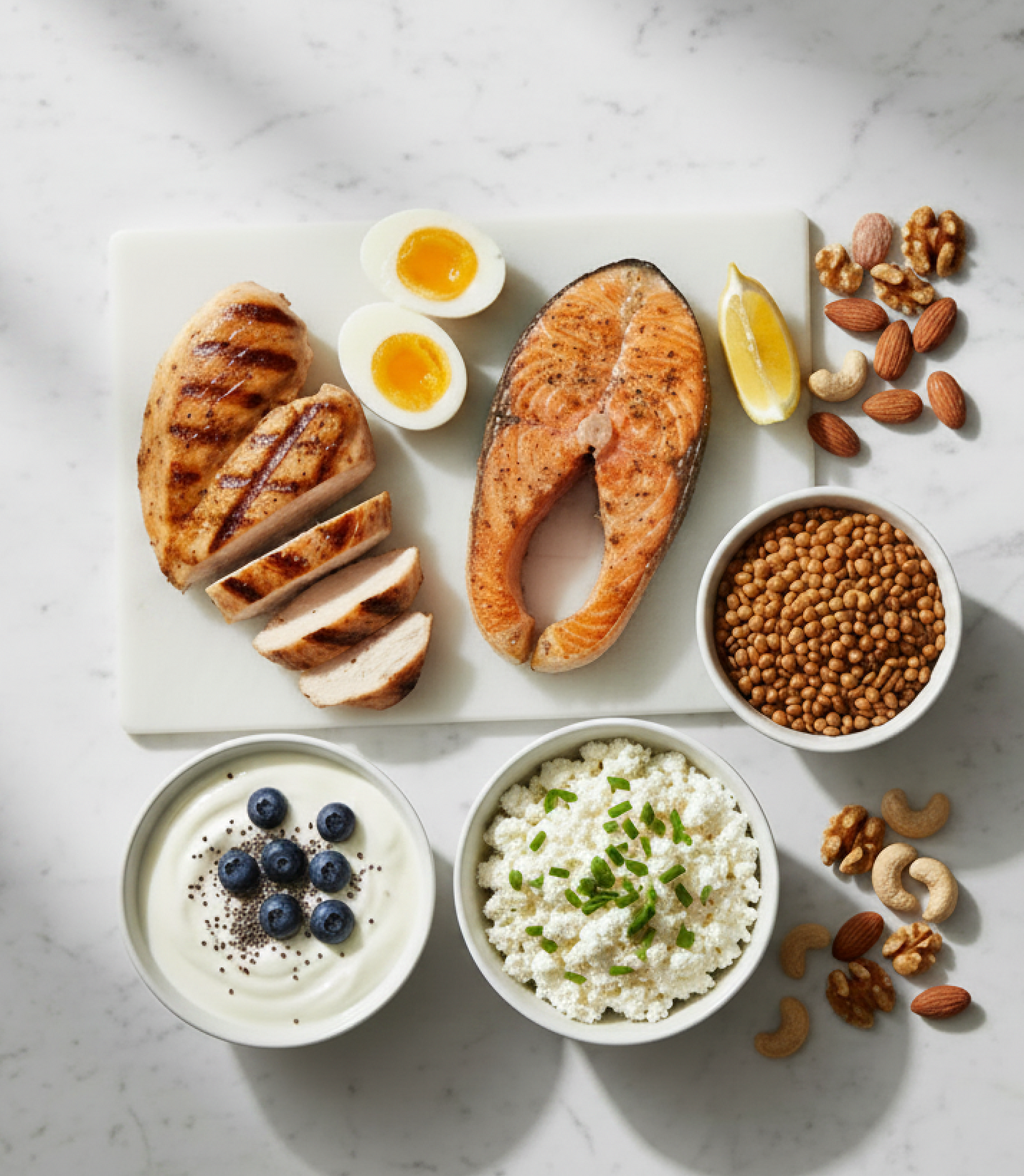
Not at all. Greek yogurt, cottage cheese, eggs, dairy, tofu, tempeh, edamame, lentils, beans, and a quality protein powder all count toward your total. Plant proteins are generally a bit less concentrated, so your portions run a little larger to hit the same grams, but the daily target is absolutely reachable without meat.
What is the easiest way to hit a high protein target?
Anchor every meal with a protein first, keep no-cook options like Greek yogurt and eggs on hand, and lean on a protein snack if your number runs high. The hardest part is the logistics, not the knowledge, which is exactly why getting enough protein without cooking is the piece worth reading next.
The bottom line
Most adults do well on 0.7 to 1 gram of protein per pound of body weight per day, with the higher end reserved for people who are training, losing fat, or getting older. Set your daily number, divide it across three meals at roughly 30 to 40 grams each, and front-load it earlier in the day. The math really is simple. Consistency is the part that takes the work.
If hitting your number is really a logistics problem, see what is on this week's menu. Every meal lists its macros, and the Protein+ plan exists for higher targets. No subscription required.
Written by the My Healthy Penguin kitchen team. Fresh meal prep made in Rancho Cucamonga, serving Southern California since 2015.
Dinner, already handled.
Fresh, macro-friendly meals delivered across Southern California.