Macros Explained Simply: Protein, Carbs, and Fat for Real People
You have probably heard people talk about "hitting their macros" like it is a second job they signed up for, complete with apps and spreadsheets and a little flicker of stress every time they eat. And I get why that makes the whole thing sound exhausting before you have even started. But here is the good news: it really does not have to be that complicated. Macros are just the three things that make up the calories in your food, and getting a handle on them is much less about math and much more about understanding what a plate is actually made of.
Once that clicks, something kind of nice happens. You stop guessing, you stop second-guessing, and you start building meals that do what you actually want them to do, whether that is keeping you full, steadying your energy, or helping you hold onto muscle. So let me walk you through the plain version: what macros are, what each one is doing for you, and how to use them without turning every single meal into a word problem.
What are macros, exactly?
Macros, short for macronutrients, are the three nutrients your body needs in large amounts and pulls its energy from: protein, carbohydrates, and fat. Every food you eat is some mix of these three, and together they account for every calorie on your plate. The quick reference, if you ever want it, is that protein and carbs each give you about 4 calories per gram, while fat is more concentrated at about 9 calories per gram.
That is genuinely the whole definition. So when someone says they are "tracking macros," all they really mean is that they are paying attention to how much of each they are eating, usually because they want more protein, steadier energy, or a little more control over their portions. And here is the part most people miss: you do not need an app to get the benefit. What you actually need is to understand what each macro does and roughly where it should land on your plate.
If you take just one idea from this section, make it this one. Calories tell you how much you ate, but macros tell you what you ate. Two meals can both be 600 calories and do completely different things to your hunger, your energy, and your body, depending entirely on how those calories are split up between the three.
What each macro actually does
Each macro is on your plate for a reason, so let me give you the short version of why each one earns its spot.
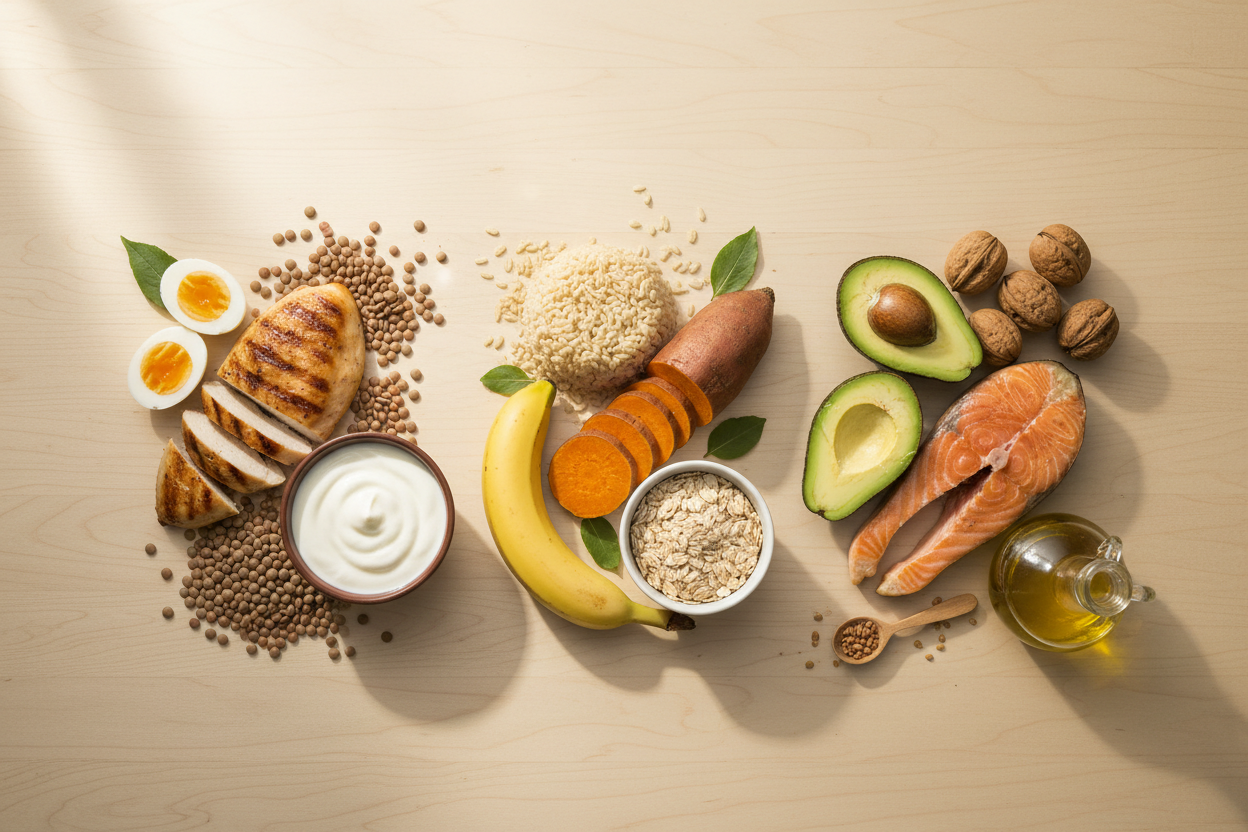
- Protein is the one that builds and repairs your muscle, keeps you fuller than anything else, and, honestly, is the macro most people quietly under-eat. It is the one worth protecting when life gets busy and your eating gets messy. Chicken, fish, beef, eggs, Greek yogurt, cottage cheese, tofu, beans, and lentils all count toward it.
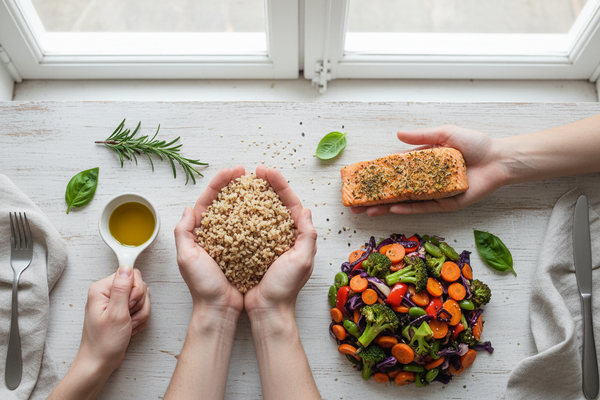
- Carbohydrates are your body's preferred fuel, especially for your brain and for anything physically demanding. They are not the villain the internet sometimes makes them out to be. What actually matters is quality, because whole grains, fruit, vegetables, and legumes behave very differently than soda and white bread. Fiber, which lives inside a lot of carb foods, slows everything down and keeps your energy from spiking and crashing.
- Fat keeps your hormones running, helps you absorb certain vitamins, and adds the satisfaction that makes a meal actually feel like a meal instead of a snack. Olive oil, avocado, nuts, seeds, and fatty fish are the ones to lean on. Just remember it is calorie-dense, so a little goes a surprisingly long way.
The honest takeaway here is that you need all three. Those popular diets that pick one macro to demonize tend to work for a little while, but usually because they trimmed your calories by accident, not because that macro was secretly out to get you.
How much of each should you eat?
I want to be straight with you: there is no single perfect split, and anyone who promises you one is probably selling it. That said, a reasonable starting frame for most adults looks something like this.
| Macro | Rough share of calories | Easy plate version |
|---|---|---|
| Protein | 25 to 35 percent | A palm to two palms per meal |
| Carbs | 35 to 50 percent | A cupped hand or two of grains, fruit, starchy veg |
| Fat | 25 to 35 percent | A thumb or two of oils, nuts, avocado |
Notice how those ranges overlap and leave you some breathing room. That is on purpose. Your ideal split really does depend on your goals, how active you are, and, frankly, what you actually enjoy eating. Someone training hard is going to want more protein and more carbs, while someone parked at a desk most of the day can run a little lower on carbs and feel great. The plate method in that last column gets you most of the way there without a food scale anywhere in sight.
And if you want one number to anchor everything else to, start with protein. For most adults, somewhere around 0.7 to 1 gram of protein per pound of body weight per day is a solid target, and it has a nice way of fixing portion problems on its own simply because protein is so filling. If you want to go deeper on that, our full breakdown of how much protein you actually need per day gets into the specifics.
How to use macros without obsessing
Let me give you the honest tradeoff here, because I think it matters. Counting every gram in an app is genuinely useful for a few weeks if you truly have no idea what you are eating right now. It is a fantastic teaching tool, almost like training wheels. But for most people it makes a miserable long-term lifestyle, and for some it can quietly tip into an unhealthy, anxious relationship with food. So I would not want you to live there forever.
The sustainable version is a good deal looser, and it really comes down to a handful of habits.
- Build every meal around a protein first. Decide on the protein, then add your carbs and your vegetables around it. This one habit fixes more than any app ever will.
- Make half your plate vegetables. They are mostly fiber and water, they fill you up, and they barely move your calorie total, which is about as close to a free lunch as nutrition gets.
- Let your carbs match your activity. Bigger portions on the days you train, smaller ones on the days you are on the couch. You do not have to cut them out, you just scale them up and down.
- Stop weighing once you can eyeball it. The whole point of measuring is to learn what portions look like, and then to graduate. Our guide to eyeballing portion sizes covers the hand method if you want a cheat sheet.
What you are really after is a plate you can recreate without thinking hard about it. Macros are a lens you look through, not a leash you wear.
Where pre-portioned meals make this easier
Here is something that does not get said enough: the fastest way to learn what good macros actually look like is to eat meals where the numbers are already done for you. When every meal lists its protein, carbs, and fat right there on the label, you slowly start to internalize what 40 grams of protein or 50 grams of carbs looks like on a real plate. And that, almost as a side effect, makes your own home cooking better too.
That is one of the reasons every My Healthy Penguin meal lists full macros on the label. You are not only buying convenience, you are buying a reference point you can carry into the rest of your fridge. Learning to read those numbers connects directly to reading a nutrition label for your actual goals, which is really the same skill pointed at anything you pick up at the store.
FAQ
Do I have to count macros to be healthy?
Not at all. Plenty of people eat well their whole lives without ever counting a single gram. Macros are a tool for when you have a specific goal, like gaining muscle or losing fat, and you want a little more precision than "just eat better" gives you. The plate method gets you most of the benefit with none of the tracking, so feel free to start there.
Which macro is most important?
For most goals, I would say protein, simply because it is the one people tend to under-eat and the one that protects your muscle and reins in your hunger. Carbs and fat both matter too, but if you are only going to nail one thing, make it getting enough protein at each meal.
Are carbs bad for you?
No, and I would gently push back on anyone who says otherwise. What matters is the quality and the quantity, not the macro itself. Whole, fiber-rich carbs like fruit, vegetables, beans, and whole grains support your energy and digestion. The ones actually worth limiting are the refined carbs with added sugar and not much else going for them.
How do I figure out my own macro split?
Start with a protein target based on your body weight, fill half your plate with vegetables, and let your carbs flex with how active you are. Eat that way for a couple of weeks, then adjust based on your energy, your hunger, and how you look and feel. There is genuinely no need to nail it perfectly on day one.
The bottom line
When you strip away all the noise, macros are just protein, carbs, and fat, the three things every meal is built from. You really do not need an app to use them well. Anchor each plate with a protein, fill half of it with vegetables, scale your carbs to your activity, and you are already doing the thing all that tracking was meant to teach you in the first place.
If you would rather have meals with the macros already counted and printed on every label, see what is on this week's menu. No subscription required.
Written by the My Healthy Penguin kitchen team. Fresh meal prep made in Rancho Cucamonga, serving Southern California since 2015.
Dinner, already handled.
Fresh, macro-friendly meals delivered across Southern California.