How to Read a Nutrition Label for Your Actual Goals
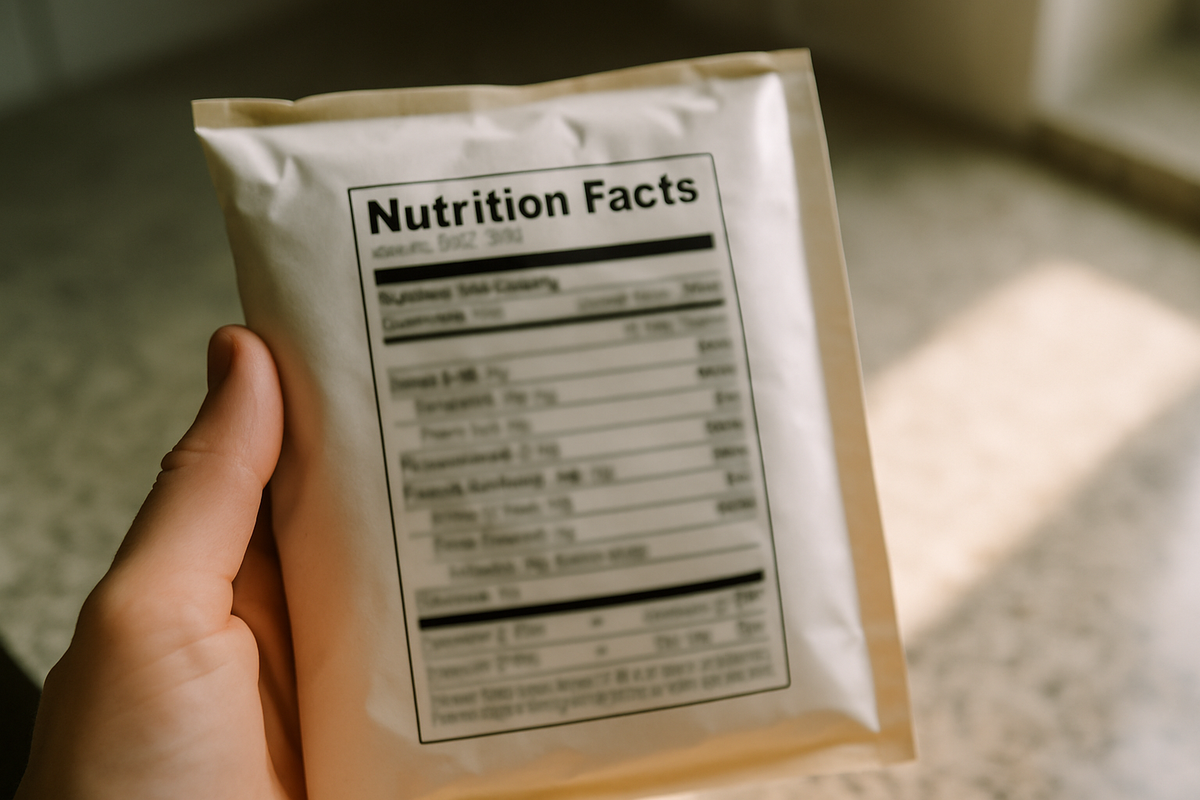
Here's the thing almost nobody bothers to tell you about nutrition labels: most of what's printed on them just doesn't matter for your day-to-day decisions. People stand in the aisle squinting at the whole panel, get completely overwhelmed, and then either give up entirely or fixate on the one number some marketing trend told them to be afraid of. The genuinely useful move is the opposite of all that. You learn the four lines that actually predict whether a food helps your goals, you read those, and you let everything else quietly fade into the background.
So this is the practical version. The handful of numbers worth your attention, the one sneaky trick that quietly undoes all of them if you miss it, and how to read a label in roughly ten seconds without losing your mind.
What should you actually look at on a nutrition label?
For most goals, four things on a nutrition label do the real heavy lifting: the serving size (because every other number on the panel depends on it), the protein (the macro most people consistently under-eat), the fiber (a surprisingly strong signal of food quality), and the added sugar (the number most worth keeping an eye on). Glance at just those four and you can size up a food fast. Total calories and total fat matter too, of course, but they're easier to estimate on your own and less likely to mislead you than these four are. Read the four that count and you skip almost all of the usual confusion.
And the order genuinely matters here: always check serving size first, because it's the lever that changes everything else on the panel.
Start with serving size, or the rest lies to you
Serving size is the most ignored line on the whole label and also the most important, which is a frustrating combination. Every number below it, the calories, the protein, the sugar, all of it, is per serving, and the serving they've listed is very often smaller than what you'd actually eat in real life. A bag of chips might list 150 calories per serving and then quietly contain three servings, so the whole bag is really 450 calories. A "single" bottle of soda is frequently two servings hiding in plain sight. So before you trust any other number on the panel, check the serving size, check how many servings the package actually holds, and do the quick multiplication for what you'll really eat. Skip that one step and a perfectly "healthy" looking label can be hiding double or triple what you assumed.
The four numbers that matter most
Once the serving size is settled, scan these four, in this order:
- Protein. This is the macro most people fall short on, and it's the one that keeps you full and protects your muscle. Higher is usually better here. A food with meaningful protein per serving is doing more for you than the same number of calories coming from carbs alone. If protein targets are still new to you, our guide to macros in plain language connects the dots nicely.
- Fiber. Fiber is a quiet little quality signal. Whole, minimally processed foods tend to have it, and heavily processed foods tend not to. More fiber means steadier energy and better fullness, so go ahead and treat a decent fiber number as a green flag.
- Added sugar. This is the line most worth limiting, and the good news is the label now separates it out from the naturally occurring sugar. The added sugar in fruit and dairy genuinely isn't the concern. It's the added sugar dumped into the sauces, the snacks, and the drinks that you're watching for. Lower is better on this one.
- Calories. Useful for context, especially once you've adjusted for the real serving size, but it's the number you can estimate most easily on your own, and the one least likely to surprise you if you got the serving size right in the first place.
Read the ingredient list too
The numbers tell you how much. The ingredient list tells you what. A few fast habits worth picking up:
- Order matters. Ingredients are listed by weight, with the most first. So if sugar or a refined oil is sitting right near the top, that tells you quite a lot in a hurry.
- Shorter is often better, though not always, so don't be dogmatic about it. A long list of recognizable whole foods is perfectly fine. A long list of additives and sweeteners is more of a flag.
- Watch for sugar's many aliases. Cane juice, the various syrups, anything ending in "ose." Several different sugars can get split across the list specifically to keep any single one of them from showing up near the top.
The ingredient list is really where you catch the ultra-processed foods that a clean-looking number panel can disguise, which is the whole heart of cutting back on ultra-processed food.
A ten-second label scan
| Step | What to check |
|---|---|
| 1 | Serving size and servings per package |
| 2 | Protein (higher is usually better) |
| 3 | Fiber (a quality signal, more is good) |
| 4 | Added sugar (lower is better) |
| 5 | First three ingredients |
Run any package through that little sequence and you'll judge it accurately in seconds, without ever getting lost in the rest of the panel.
Honest caveat: labels are a tool, not a verdict
I want to be straight with you about this part. A nutrition label tells you what's in a food, not whether it fits your life or your goals on a given day, and that distinction matters. Context is everything. A higher-calorie meal is great after a hard workout and complete overkill on the couch. And a food with no label on it at all, like an apple or a piece of fish, is often the best choice on the entire shelf. So use labels to compare similar products and to keep yourself from being fooled by the serving-size tricks, not to assign foods some kind of moral score. This is general information, not personalized nutrition advice, so if you're managing a specific health condition, please work with your care team on targets that actually fit you.
FAQ
What is the most important thing on a nutrition label?
Serving size, without much competition. Every other number, the calories, the protein, the sugar, is listed per serving, and that listed serving is often smaller than what you'd really eat. So check it first, then multiply for your actual portion, or the rest of the label will quietly mislead you.
Should I worry about total sugar or added sugar?
Added sugar is the one to watch, and the label separates the two now, which helps. The naturally occurring sugar in fruit and plain dairy comes packaged with fiber and nutrients, so it isn't the concern. The added sugar in snacks, sauces, and drinks is the line most worth keeping low.
Are calories the number that matters most?
They matter, but honestly less than people tend to think for quick, in-the-aisle decisions. Once you've adjusted for the real serving size, calories are pretty easy to estimate. Protein, fiber, and added sugar tell you more about a food's actual quality and how it'll affect your hunger and energy.
How much protein or fiber should a food have?
There's no single magic number per food, since it really depends on the rest of your day. As a quick heuristic, just favor foods with meaningful protein and a few grams of fiber per serving over similar foods with little of either. The overall pattern across your day matters far more than any one item.
Why is the ingredient list useful if I have the numbers?
Because the numbers say how much, but the ingredients say what. They're listed by weight, so the first few reveal what a food mostly actually is. The list also quietly exposes added sugars hiding under different names, along with the additives that mark out the heavily processed foods a tidy number panel can otherwise disguise.
The bottom line
Check the serving size first, then scan the protein, the fiber, and the added sugar, and glance at the first few ingredients. Those few lines tell you almost everything a label can, in about ten seconds, and the rest you can comfortably let go of.
Prefer food that does the math for you? See what is on this week's menu. Every meal lists its full macros, with no decoding required and no subscription.
Written by the My Healthy Penguin kitchen team. Fresh meal prep made in Rancho Cucamonga, serving Southern California since 2015.
Dinner, already handled.
Fresh, macro-friendly meals delivered across Southern California.