Why Meal Prep Works for Weight Loss When Diets Don't
Here's something I think most people get backwards about dieting. When a diet falls apart, we tend to blame ourselves, like we just didn't want it badly enough. But honestly, most diets don't fail because the rules are wrong. They fail because they ask you to make the right choice forty times a week, every single week, while you're tired, busy, and surrounded by easier options. Willpower works a lot like a phone battery, and "figure out the healthy thing to do" drains it fast. By Thursday night the battery is at two percent, and the takeout menu wins without much of a fight.
Meal prep works for a pretty boring reason that has nothing to do with motivation. It moves the big decision to a moment when you actually have the energy to make it well, and then it gets out of your way for the rest of the week. That's the whole trick, and it's why prepping food tends to beat dieting for people who already know what to do and just can't seem to do it consistently.
Why does meal prep work better than dieting for weight loss?
The short answer is that meal prep removes the in-the-moment decisions and locks in your portions before hunger and fatigue can hijack them. Weight loss really does come down to a sustained calorie deficit, but the thing that wrecks most deficits isn't a lack of knowledge. It's the hundred tiny choices you make while hungry, rushed, or stressed out of your mind. When your meals are already portioned and waiting in the fridge, the hard choice has already been made. You just eat the food that's there.
Put it this way: dieting asks you to win an argument with yourself every time you eat. Meal prep skips the argument entirely, which is exactly why it sticks when nothing else does.
The real problem isn't knowledge, it's decision fatigue
Let me be honest with you about something. Almost everyone trying to lose weight already knows the basics. Eat more protein and vegetables, go a little easier on the refined carbs, watch the liquid calories. Knowing what to do was never really the bottleneck.
The bottleneck is that every unplanned meal turns into a fresh little negotiation. What do I actually want, what's fast, what's even in the fridge, what can I talk myself into. Each of those negotiations costs you a sliver of willpower, and you run out of it long before the week does. This is the whole reason people eat beautifully all day and then come completely undone at 8 p.m. It isn't weakness, and I really want that to land. It's a drained decision-making battery meeting an empty fridge, which is a setup almost nobody wins.
Meal prep goes straight at that problem. You make the decisions once, on a calm afternoon when you've got a little gas in the tank, and you make them for the whole week. After that, there are simply no more negotiations left to lose.
How meal prep fixes the three things that sink weight loss
A good prep system quietly handles the problems that diets tend to leave wide open:
- Portions. Restaurant and takeout portions are calibrated to feel generous, not to be appropriate for you. A pre-portioned meal ends that slow creep of "just a little more" that quietly adds up across a week. And if you'd rather not weigh anything, you can learn to eyeball portion sizes without measuring using your hand as a guide.
- The hungry-and-unprepared gap. The real danger zone is that moment when you're hungry with no plan. That's when the drive-thru and the snack drawer take over. Prepped food just removes the gap, because there's always a real meal sitting one reheat away.
- Tracking, if that's your thing. When your meals are repeatable and labeled, you actually know what you ate, instead of guessing at the calories in some mystery burrito. And even if you never log a single thing, the consistency does most of the work for you.
None of this asks you to follow a special diet. It just asks that the food already exists before you're hungry, which turns out to be the part that changes everything.
What a weight-loss prep week actually looks like
You don't need restaurant skills or six lost hours on a Sunday for this. A perfectly workable week looks something like this:
- Pick three or four meals you genuinely like. Repetition is a feature here, not a failure. Trust me, variety is where most prep plans quietly go to die.
- Build each plate around protein and vegetables. Protein keeps you full and protects your muscle while you lose fat, and vegetables add a lot of volume for very few calories. Starch is the supporting actor on the plate, not the lead.
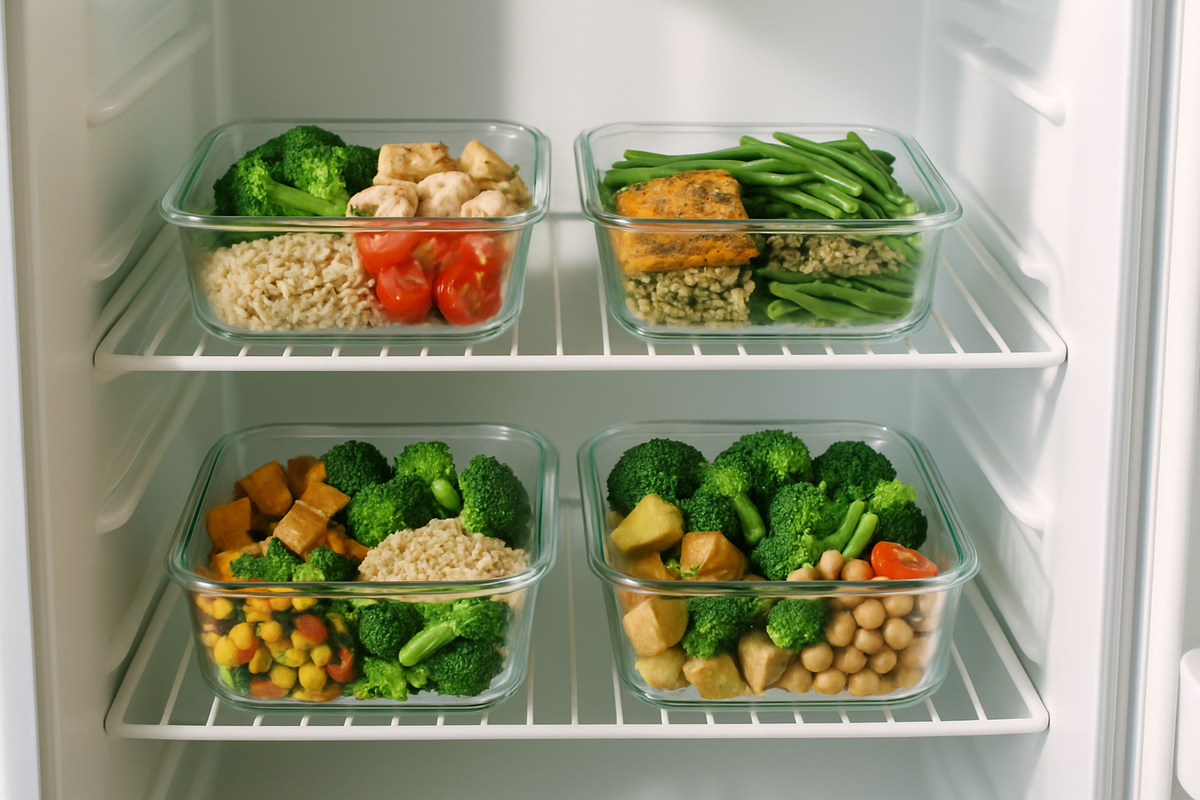
- Portion into single servings. Let the container be the portion. No serving yourself off a big tray and promising to eyeball it sensibly later, because we both know how that goes.
- Make the default the easy choice. Front of the fridge, at eye level, ready to grab. The healthy option has to also be the lazy option, or a stressful day will pick something else for you.
If you're brand new to all of this, you really don't need a flawless system on day one. A simple beginner's approach to meal prepping is plenty to get going, and you can fine-tune the portions as you learn what fills you up.
Here's how a prepped day stacks up against the same day improvised:
| Meal | Improvised day | Prepped day |
|---|---|---|
| Breakfast | Skipped, then coffee | Eggs and yogurt, already portioned |
| Lunch | Whatever's fast nearby | Chicken bowl from the fridge |
| Snack | Vending machine | Cottage cheese or fruit on hand |
| Dinner | Too tired, order out | Salmon and veggies, reheat in minutes |
Same person, same willpower, same tiring week. The only real difference is which version required a good decision while completely exhausted, and which one didn't.
Who this works for, and who it doesn't
I want to be straight with you, because meal prep isn't magic and it isn't for everyone. If you love cooking and find it genuinely relaxing, batch-cooking your own meals is the cheapest version of this and it works beautifully. The system is what matters, not who's doing the chopping.
It also won't out-run a real medical issue, a thyroid condition, or a medication side effect. If the scale just won't budge despite consistent, honest effort, that's a conversation to have with your doctor, not a sign you need to prep even harder.
But for the very common case of a busy person who knows exactly what to do and just can't execute it day after day, removing the daily decision is often the single highest-leverage change you can make. It beats starting another diet just about every time.
FAQ
Is meal prep actually better than a diet plan for losing weight?
For most people, honestly, yes, because the failure point of dieting is consistency, not knowledge. A diet plan tells you what to do. Meal prep gets you to actually do it by quietly removing the in-the-moment decisions. The best diet is simply the one you can repeat, and prepped food is far easier to repeat week after week.
How many meals should I prep to lose weight?
Start with whichever meals you most often improvise badly, which for most folks is lunch and dinner. Prepping three or four repeatable meals usually covers most of the week without burning you out, and you can keep breakfast easy with no-cook staples like eggs and Greek yogurt.
Do I have to count calories if I meal prep?
Not necessarily. Pre-portioned, protein-forward meals tend to create a calorie deficit on their own, just by controlling your portions and curbing the snacking. Counting can speed things up and add some precision if you like that, but plain old consistency with sensible portions does most of the heavy lifting.
What if I get bored eating the same prepped meals?
Boredom is the main reason prep plans collapse, so it's worth planning around from the start. Rotate two or three protein and sauce combinations, switch up the vegetables, and leave one or two flexible meals out each week. A little built-in variety protects the whole system.
Will meal prep work if I don't cook?
Yes, it really will. The principle is removing decisions and controlling portions, and cooking is just one way to get there. No-cook staples and ready-to-eat prepared meals deliver the same effect without you ever touching the stove.
The bottom line
Diets ask you to make the right choice over and over while you're tired and busy, and that's exactly the moment willpower tends to give out. Meal prep wins by making the decision once, controlling the portion, and showing up before hunger does. Remove the decision, and the deficit has a way of taking care of itself.
If cooking is the step that keeps falling apart for you, you're allowed to outsource it. See this week's menu, where every meal is portioned and lists its full macros, with no subscription to deal with.
Written by the My Healthy Penguin kitchen team. Fresh meal prep made in Rancho Cucamonga, serving Southern California since 2015.
Dinner, already handled.
Fresh, macro-friendly meals delivered across Southern California.